April is Distracted Driving Awareness Month, bringing attention to a serious issue on the roads. Here’s what NIOSH recommends that employers do to prevent distracted driving.

Practical EHS Tips, News & Advice. Updated Daily.
April is Distracted Driving Awareness Month, bringing attention to a serious issue on the roads. Here’s what NIOSH recommends that employers do to prevent distracted driving.

Guam contractor Giant Construction Corp. faces $1,038,918 in Occupational Safety and Health Administration (OSHA) fines for trenching violations. Federal inspectors found employees working in trenches deeper than 5 feet without required safety equipment. Giant Construction, a Tamuning contractor, was installing sewer lines in multiple trenches at a worksite in the Palisades Subdivision Project in Tiyan. […]
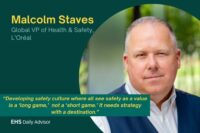
Malcolm Staves is the global vice president of health and safety at L’Oréal, a multinational giant in the beauty and cosmetics industry. Since joining the company about 16 years ago, Staves has worked to improve corporate safety culture not just at L’Oréal, but in the world at large. L’Oréal has around 88,000 employees, and its […]

With the EPA finalizing the first-ever national, legally enforceable drinking water standard to protect communities from exposure to harmful per- and polyfluoroalkyl substances (PFAS), the next obvious question becomes: Who is legally liable for both the consequences of their presence and the cost of removing these chemicals from drinking water? The U.S. Senate Committee on […]

In this episode of EHSDA Shorts, Kathy A. Seabrook, CEO & Founder of Global Solutions, Inc., explains what ESG is and how it can be integrated with EHS.

Back to Basics is a weekly feature that highlights important but possibly overlooked information that any EHS professional should know. This week, we take a look at the OSHA 300 log and how to use it. If you’ve ever questioned what to record on your OSHA Form 300, short for OSHA Log of Injuries and […]

Are you an environment, health, and safety (EHS) professional with something to contribute to your professional community? If so, we want to hear from you! Faces of EHS is our feature series where we profile leaders in the EHS industry, shining a light on their background, best practices, trends, and, most importantly, how they keep […]
The construction industry fall protection standard remains the Occupational Safety and Health Administration’s (OSHA) most frequently cited standard for the 12th year in a row, the agency announced on September 20. Patrick Kapust, acting director of OSHA’s Directorate of Enforcement Programs, presented a list of preliminary figures for fiscal year (FY) 2022—the fiscal year ends September […]
April is Distracted Driving Awareness Month, bringing attention to a serious issue on the roads. Here’s what NIOSH recommends that employers do to prevent distracted driving.
In this episode of EHSDA Shorts, Kathy A. Seabrook, CEO & Founder of Global Solutions, Inc., explains what ESG is and how it can be integrated with EHS.